Sightline calculations, riser dimensions, room requirements, and seat capacity charts for every 2-row home theatre recliner installation.
What room size do I need for a 2-row home theatre?
A standard two-row home theatre needs about 18 ft of depth — roughly 1.5 ft walkway, 6 ft front row, 2.5 ft mid-walkway, 6 ft back row and 2 ft at the rear. A 16 ft room may qualify as a compact two-row after a free site assessment.
Does the back row need a riser?
For clear sightlines the back row usually sits on a 6–12 inch riser so viewers behind can see over the front row. We calculate the exact riser height from your screen and seat positions.
Can Sky Recliners plan my 2-row layout?
Yes — send your room dimensions on WhatsApp for a free layout plan, or book a free site assessment. Every recliner is then made to order to fit your exact room.
Plan your room free: map seats, rows and aisles to your exact space with our Home Theatre Layout Planner, or upload a room photo to the AI Room Planner.
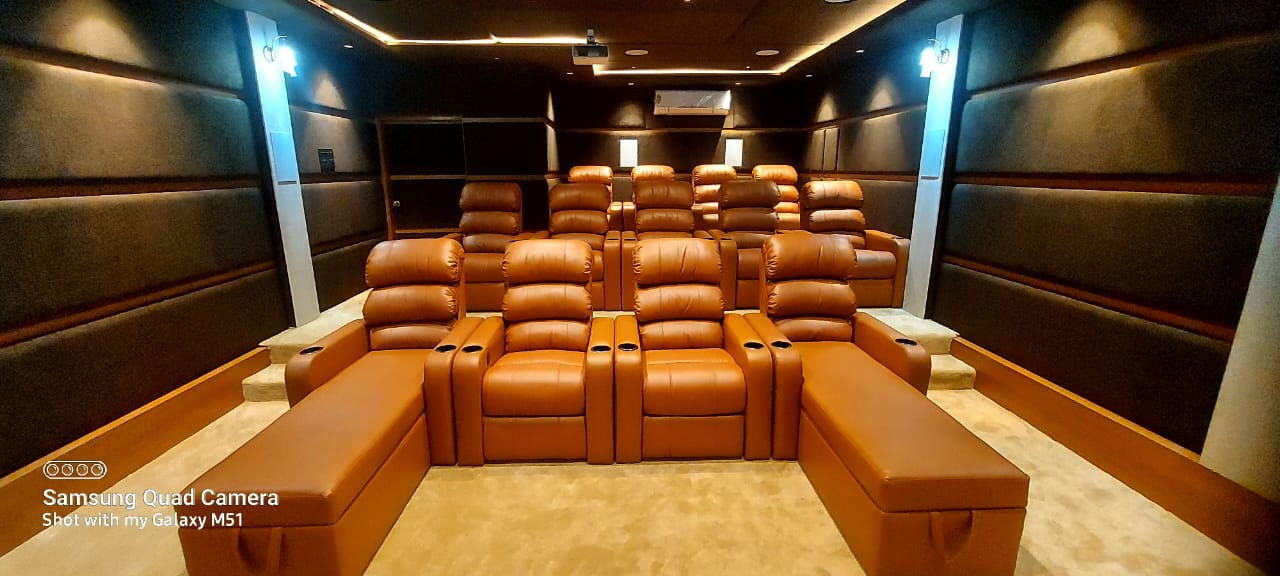
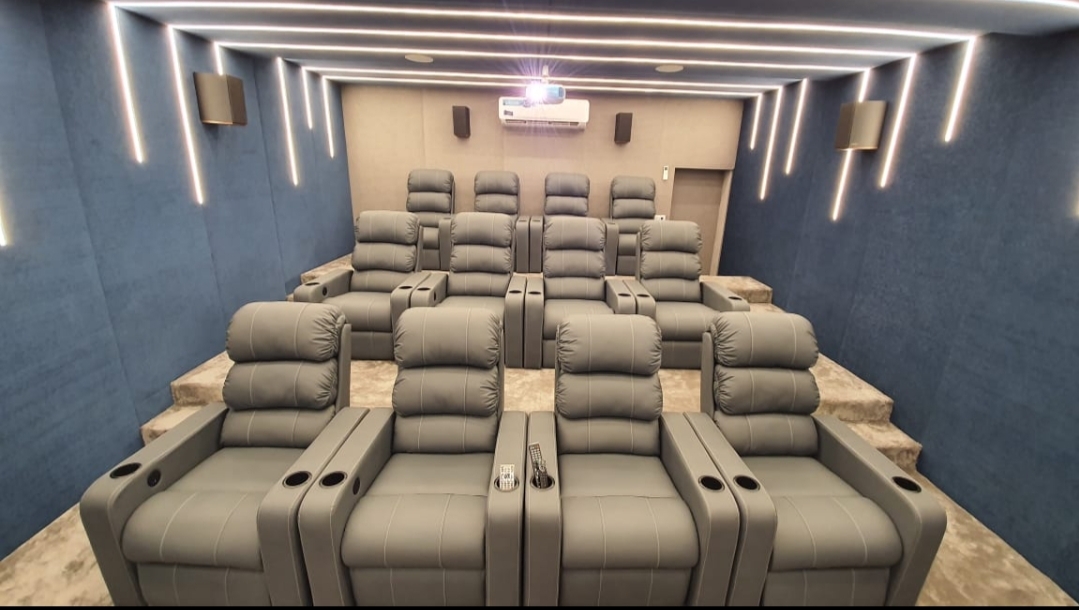
A 2-row home theatre places a second elevated row of recliners behind the first row on a raised platform called a riser. The rear row sits 12–15 inches higher than the front row, giving rear viewers a clear sightline over the front row headrests — exactly like a commercial cinema.
These Sky models suit this room — built to order and sized to your exact space, factory-direct with German motors and a 5-year mechanism warranty.
| Recommended model | Seats | Price |
|---|---|---|
| Classic 4-Seater Theater | 4 | From ₹1,15,000 |
| Galaxy 4-Seater Recliner Sofa | 4 | From ₹1,15,000 |
| Elite 4-Seater Theater | 4 | From ₹1,75,000 |
Yes — with a 15 inch riser, the rear viewer’s eye level is 13 inches above the front row headrest. Here is the exact geometry.
| Measurement | Front Row | Rear Row (15" Riser) |
|---|---|---|
| Eye level from floor | 42" (seated adult avg.) | 57" (+15" riser) |
| Headrest top from floor | 44" | 59" (+15" riser) |
| Eye clearance above front headrest | — | 13" ✓ |
| Viewing distance to screen | ~5.5 ft (close) | ~12 ft (optimal) |
| Ideal screen size | Works with 120–150" | Best at 135–150" |
✓ Minimum riser for basic clearance: 3 inches (rear eye just above front headrest). But for comfortable viewing — head naturally tilted slightly upward — we recommend 12–15 inches. Standard Sky Recliners 2-row installation uses 15 inches.
The riser (elevated platform for the rear row) is built by a local contractor before the chairs are delivered. Sky Recliners provides the specifications. Here is everything your contractor needs.
| Riser Specification | Standard Value |
|---|---|
| Riser Height | 15" (38 cm) |
| Riser Depth (front to back) | 60–72" (5–6 ft) |
| Riser Width | Room width minus 4" each side |
| Material | Cement/brick or wood frame + tile |
| Front edge finish | LED strip lighting (optional) |
| Electrical conduit | Run 2–4 conduits (for motor wires) |
| Build time | 2–3 days |
| Curing time before chairs | 7 days (cement), 1 day (wood) |
⚡ For motorized recliners: Run 2–4 electrical conduits through the riser before tiling. Each rear row seat needs one power outlet. Running wires after tiling is expensive. Sky Recliners will advise the exact conduit route during the pre-delivery site visit.
Room DEPTH determines if 2 rows are possible. Room WIDTH determines how many seats fit per row. Minimum 18 ft room depth (standard).
⚠ Minimum depth calculation: 1.5 ft (front clearance) + 6 ft (row 1 platform) + 2.5 ft (riser walkway) + 6 ft (row 2 platform) + 2 ft (rear clearance) = 18 ft standard minimum. Standard 2-row: 18 ft minimum depth. Compact 2-row (16 ft rooms): possible with side-aisle circulation (2–2.5 ft continuous free width beside the seat block) and movie-mode recline configuration — requires a free site assessment. WhatsApp us your room size: +91 97171 94797.
2-row seat capacity for any room combination. Seat width 24" standard with shared arms (29.5" per additional seat). Rooms must be at least 18 ft deep for 2 rows. Compact 2-row in 16 ft rooms is assessed per room.
| Room Width | Seats Per Row | 2-Row Total | Unit Width Per Row | Side Clearance | Min Room Depth |
|---|---|---|---|---|---|
| 10 ft | 3 | 6 | 94" / 7.8 ft | ~1.1 ft | 18 ft |
| 12 ft | 4 | 8 | 123.5" / 10.3 ft | ~0.35 ft | 18 ft |
| 13 ft | 4 | 8 | 123.5" / 10.3 ft | ~0.85 ft | 18 ft |
| 14 ft | 5 | 10 | 153" / 12.75 ft | ~0.625 ft | 18 ft |
| 15 ft | 5 | 10 | 153" / 12.75 ft | ~1.13 ft | 18 ft |
| 16 ft | 5 | 10 | 153" / 12.75 ft | ~1.625 ft | 18 ft |
| 18 ft | 6 | 12 | 182.5" / 15.2 ft | ~1.4 ft | 18 ft |
| 20 ft | 7 | 14 | 212" / 17.67 ft | ~1.17 ft | 18 ft |
💡 For all room widths where clearance is under 6 inches, use custom 23" seat size at no extra charge. This saves 6.5" per row, significantly improving side clearance. For example: 12 ft wide room with 23" seat gives 117" unit width, improving clearance from 4" to 15" per side.
A 2-row home theatre has two cost components: the recliners (factory-direct from Sky Recliners) and the riser construction (by your local contractor). Below is a breakdown for an 8-seater in a 12×16 room.
The standard minimum is 18 feet: 1.5 ft (front clearance) + 6 ft (row 1 platform) + 2.5 ft (riser walkway) + 6 ft (row 2 platform) + 2 ft (rear clearance). Standard 2-row: 18 ft minimum depth. Compact 2-row (16 ft rooms): possible with side-aisle circulation (2–2.5 ft continuous free width beside the seat block) and movie-mode recline configuration — requires a free site assessment. WhatsApp us your room size: +91 97171 94797.
Yes, clearly. With a standard 15 inch riser, the rear viewer's eye level rises from 42 inches to 57 inches above the floor. The front row headrest top is 44 inches. This gives 13 inches of eye clearance above the front headrest — more than enough for a clear unobstructed sightline to any size screen, even if the front row person is slightly taller than average.
The recommended riser height is 12 to 15 inches. The minimum for a functional sightline is 3 inches, but this gives almost no comfortable clearance. At 12 inches, rear eye level rises to 54 inches vs 44 inch front headrest, giving 10 inches of clearance — comfortable. At 15 inches, clearance is 13 inches, which is our standard recommendation. Sky Recliners specifications always use 15 inches unless the ceiling height or room constraints require otherwise.
No — rear row chairs recline to approximately 45–50 degrees rather than fully flat. Full recline (66 inches depth) requires free space behind the chair, but in a 2-row setup the rear row chairs are positioned against or very close to the back wall. The recline is still comfortable and the footrest extends independently with dual or triple motor configurations. Most viewers in a cinema setting do not fully recline anyway.
We provide the complete riser specification — height, depth, width, electrical conduit routing, and front edge detail. The construction itself is done by your local contractor (mason or carpenter). We conduct a site visit before delivery in Delhi NCR to verify riser dimensions are correct. If the riser height is wrong after construction, chair heights can be adjusted slightly using base extensions, but it is far better to get the riser right before tiling.
A 12 ft wide room accommodates 4 seats per row with standard shared arms (123.5 inch unit). In two rows, that is 8 seats total. With custom 23 inch seat size, the unit width drops to 117 inches, giving 7.5 inches clearance per side vs 4 inches with standard 24 inch seats. A 14 ft wide room fits 5 seats per row for a total of 10 seats in two rows.
A cement and brick riser is permanent — removing it requires breaking and retiling, which damages the original floor and costs approximately the same as the original construction. A wood-frame riser with a plywood deck can be dismantled and rebuilt if needed. We recommend cement risers for dedicated home theatre rooms and wood risers for spaces that may have a different use in future. Wood risers also take 1 day to build vs 2–3 days for cement, with no curing time.
Share your room dimensions and we will design the exact riser specification, seat configuration, and full budget estimate for your 2-row setup.